Resources
Rights & Benefits
Explore
Resources
Rights & Benefits
Explore

ABS Challenge Strike Zone Comparison
Complete ABS challenge K-Zone Data
As we’ve gathered feedback from clubhouses on MLBs proposal to use ABS Challenge in 2026, one of the key questions raised by Players is the actual size of the proposed ABS Challenge strike zone – and specifically the placement of the ‘top of the zone’. We have requested and analyzed a number ‘zone comparisons’ from MLB which are available to review below.
Key Takeaways Based on the Data
Because every Player will have an individual strike zone based on his individual height (before taking his stance), not all Players will be impacted the same.
For many Hitters, but not all, the proposed ABS Zone will be lower on the top and higher on the bottom than the currently called zone, especially when the pitch is over the heart of the plate.
Because the proposed ABS Zone is a true rectangle, not the ‘oval’ zone that data shows is currently called - some areas of the zone, like the corners at the top and bottom of the Zone will likely see an increase in ‘called strikes’.
The proposed ABS will be consistent regardless of count. This will be a change from the zone that is currently called by umpires, which data shows changes in size depending on the count.
Included below you will find information about the current strike zone, along with visualizations that show key comparisons between the current zone and MLB’s proposed ABS Zone.
Current Strike Zone Facts
As background, below are some basic facts about the current strike zone.
Rulebook Zone: The strike zone is defined in the rulebook as “the area over home plate from the midpoint between a batter's shoulders and the top of the uniform pants -- when the batter is in his stance and prepared to swing at a pitched ball -- and a point just below the kneecap.” This is a 3-D Strike Zone.
ZE Zone: Umpires are graded using a ‘ZE Zone’– which is different than the ‘rulebook’ strike zone. As we understand it, the ZE Zone is a 3-D zone over the home plate area with the top and bottom set as follows:
Top of the Zone: 1.5 ball widths above the top of the batter’s belt buckle.
Bottom of the Zone: the hollow beneath the batter’s back kneecap.
The ZE zone also has ‘buffers’ built in for grading purposes. Those buffers are 1" above and 1" below the top and bottom of the ZE Zone.
Called Zone: Volumes of in-game data shows that the actual strike zone called by umpires – i.e., the ‘called zone’ –is shaped more like an oval, and can fluctuate based on count.
The below comparisons show the average size of the Proposed ABS zone, with a black dotted outline, and an overlay detailing how pitches in these areas are currently called based on game data.
Proposed ABS Zone vs. 50% Currently Called Zone

The average size of the proposed ABS zone is shown by the black dotted rectangle.
The red 50% dotted line shows the area where at least 50% of the pitches are currently called strikes, with the border denoting a 50% pitch. A pitch any further out is called a strike less than 50% of the time.
The red weighted average lines on the top and bottom of the zone highlight that the top of the proposed ABS zone is .76” lower than the 50% contour and the bottom is 1.06” higher than the 50% contour.
Proposed ABS Zone vs. 75% Currently Called Zone

The average size of the proposed ABS zone is shown by the black dotted rectangle.
The red 75% dotted line shows the area where at least 75% of the pitches are currently called strikes, with the border denoting a 75% pitch. A pitch any further out is called a strike less than 75% of the time.
The red contour shows that the oval area where pitches are called strikes 75% of the time (or more) is almost entirely inside the proposed ABS Zone boundaries.
Proposed ABS Zone vs. 75% Currently Called Zone (by count)


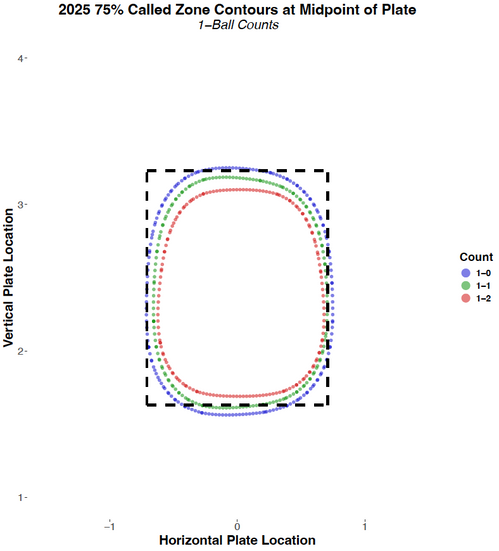


The average size of the proposed ABS zone is shown by the black dotted rectangle.
The blue, green and red 75% dotted lines on each page show the area where at least 75% of the pitches are currently called strikes by count, based on game data. (Use the arrows on the left and right to scroll between counts.)
These visualizations show the changes in the called zone as an at-bat progresses. Pitcher ahead counts tend to shrink the called zone, and pitcher behind counts expand it.
Proposed ABS Zone broken down by Heart and Shadow Zone Strike Percentages


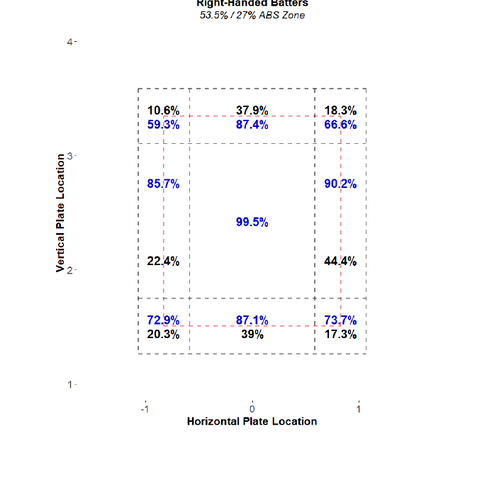
This visualization shows the proposed ABS Zone with the red dotted rectangle, and the percentages of pitches that are called strikes in each area based on game data.
Heart of the Plate: These pitches are called strikes more than 99% of the time (ABS would be 100% if a challenge was used.)
Shadow Zone (on the plate): Percentages in Blue, these are pitches up to three inches ‘in the zone’. The true corners are called 50-70% of the time, with the top, bottom and edges called 80-90% of the time. (ABS would call these strikes 100% of the time if a challenge was used).
Shadow Zone (off the plate): Percentages in Black, these are pitches up to three inches off the plate. The true corners are called strikes ranging from 9% to 20% of the time, with the top, bottom and edges called 22-44% of the time. (ABS would call these strikes 0% of the time if a challenge was used).
Key Takeaways Based on the Data
Because every Player will have an individual strike zone based on his individual height (before taking his stance), not all Players will be impacted the same.
For many Hitters, but not all, the proposed ABS Zone will be lower on the top and higher on the bottom than the currently called zone, especially when the pitch is over the heart of the plate.
Because the proposed ABS Zone is a true rectangle, not the ‘oval’ zone that data shows is currently called - some areas of the zone, like the corners at the top and bottom of the Zone will likely see an increase in ‘called strikes’.
The proposed ABS will be consistent regardless of count. This will be a change from the zone that is currently called by umpires, which data shows changes in size depending on the count.
